How to Look Confident on Camera
 By the TeleP teamUpdated 4 min read
Quick answer
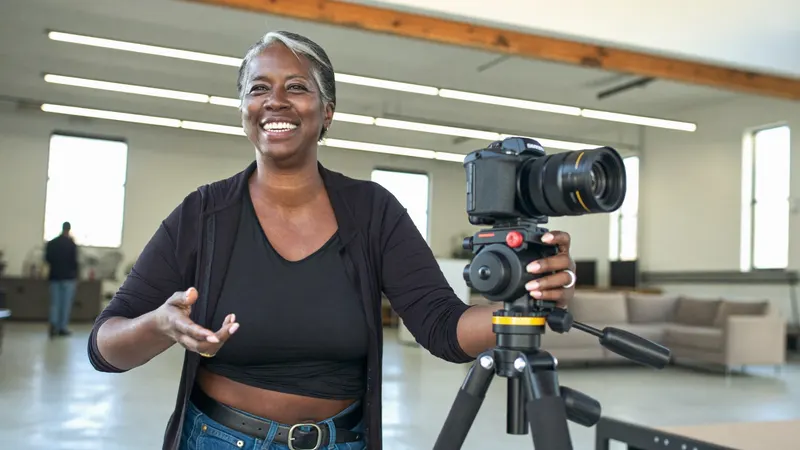
To look confident on camera, set the lens at eye level, light your face from the front, and know your opening line cold. Then slow down, pause between points, look into the lens at the start and end of each one, and use your hands as you would in conversation.
Free online teleprompter
Paste your script and read it on camera. Runs in your browser; your script is never uploaded.
Tip: in the teleprompter, press Pop out to keep the script in a small window next to your webcam.
Confidence on camera is mostly setup and preparation
Most people who look nervous on video are not doing anything wrong with their face. The camera is too low, the light is behind them, or they are trying to remember what comes next. Fix those first. Delivery tips work much better once the basics are right.
Part 1: Set up so the camera is on your side
1. Lens at eye level
A camera below your face looks up your nose and makes you look smaller. Raise the laptop or phone until the lens is level with your eyes, or very slightly above.
2. Light from the front
Face a window or put a lamp behind the camera, slightly above eye level. Light from behind turns you into a silhouette; light from directly above casts shadows under the eyes.
3. Frame with intent
Head and shoulders, eyes about a third of the way down the frame, a little space above your head. Sit or stand centered.
4. Clean background
A tidy, uncluttered background makes you the focus. You don’t need a studio; a plain wall, a bookshelf or a plant is fine.
5. Sound
Echo and muffled audio make anyone sound less sure. Record in a room with soft furnishings and keep the microphone close.
Part 2: Prepare so you are not searching for words
6. Know your first 15 seconds cold
Nerves peak at the start. If you can say the opening without thinking, your voice settles before the hard part. Rehearse it out loud five times.
7. Script the parts that matter
For the hook, key points and closing line, write the exact words and run them on a teleprompter. For the rest, bullet points are fine. Load your script into the free online teleprompter, make the column narrow and put it right under the camera so your eyes stay near the lens.
Check the length first with the words-to-time calculator, so you are not rushing to fit too much in.
8. Do a warm-up take
Record one take you plan to delete. Your second take is almost always more relaxed, because the first one burns off the nerves.
Part 3: Delivery that reads as confident
9. Slow down and pause
Nervous speakers rush. A slightly slower pace with clear pauses between points looks deliberate. If you use a teleprompter, start the scroll a step slower than feels natural and pause it between sections. The reading speed test shows you your natural pace.
10. Look at the lens at the right moments
You don’t need to stare. Look into the lens at the start of each point and at the end, especially on a key line or a question. Glance away briefly when you would naturally pause to think, then come back.
11. Use your body
- Sit or stand tall, shoulders relaxed and slightly back.
- Lean in a little toward the camera when you make your main point.
- Use your hands within the frame, at chest height, the way you would in conversation.
- Smile on the first line. It changes your voice and relaxes your face.
12. Own your mistakes
If you stumble, pause, smile and say the sentence again. In a recording you can cut it; on a live call, a calm restart looks more confident than pushing through a garbled sentence.
Quick fixes table
| What you see in the playback | Likely cause | Fix |
|---|---|---|
| Looking down a lot | Low camera or notes | Raise camera; notes under it |
| Eyes darting side to side | Reading wide lines | Narrow the teleprompter column |
| Flat, monotone voice | Reading word by word | Phrases, emphasis, pauses |
| Talking too fast | Nerves | Slow the scroll; pause between points |
| Stiff body | Concentrating on words | Rehearse more; use your hands |
| Dark face | Light behind you | Face the window; add lamp |
| “Um” and “uh” | Searching for the next idea | Script key lines; pause silently |
If you look down a lot, the camera is low or your notes are below the lens: raise the camera and move notes or script right under it. For a flat voice, read in phrases, mark emphasis and pause on purpose. For a dark face, turn around to face the window, or add a lamp in front of you.
A 10-minute practice routine
- Set up camera height, light and framing (3 minutes).
- Read your opening aloud five times (2 minutes).
- Record a warm-up take and delete it (1 minute).
- Record a real take of 60 seconds (1 minute).
- Watch it twice: once with sound off looking at your eyes and posture, once with sound on listening for pace (3 minutes).
Fix one thing at a time. After a few sessions, most people look noticeably more at ease.

Record it on your phone
TeleP scrolls your script over the iPhone camera while you record, then adds captions automatically.
Confidence checklist
- Lens at eye level
- Light in front of you
- Clean background, close microphone
- Opening line rehearsed until automatic
- Key lines scripted, in a narrow column under the lens
- Warm-up take done
- Slow pace with pauses
- Eye contact at the start and end of each point
- Hands visible and natural
Eye contact is often the biggest visible change; the guide on maintaining eye contact with the camera goes deeper.
Questions and answers
Why do I look so awkward on camera?
Usually because of setup and nerves, not your looks: a camera below your face, light from behind or above, and stiffness from trying to remember words. Fixing camera height, light and preparation removes most of it.
How do I stop being nervous on camera?
Prepare the first 15 seconds until you can say them without thinking, breathe out slowly before you start, and record a throwaway warm-up take. Knowing you can redo any take also takes the pressure off.
Should I look at the camera or the screen?
At the lens when you speak, especially at the start and end of each point. On calls, it is fine to look at people’s video while they talk.
Does using a teleprompter make you look less confident?
Only if your eyes visibly sweep or you read in a flat rhythm. With the text in a narrow column right at the lens and rehearsal beforehand, a teleprompter usually makes people look more confident, because they are not searching for words.
What should I do with my hands on camera?
Use them the way you would in conversation, within the frame and around chest height. If you have nothing to do with them, rest them loosely together at your waist, out of the frame or just inside it.