Teleprompter Glass: Beam Splitter vs Mirror
 By the TeleP teamUpdated 4 min read
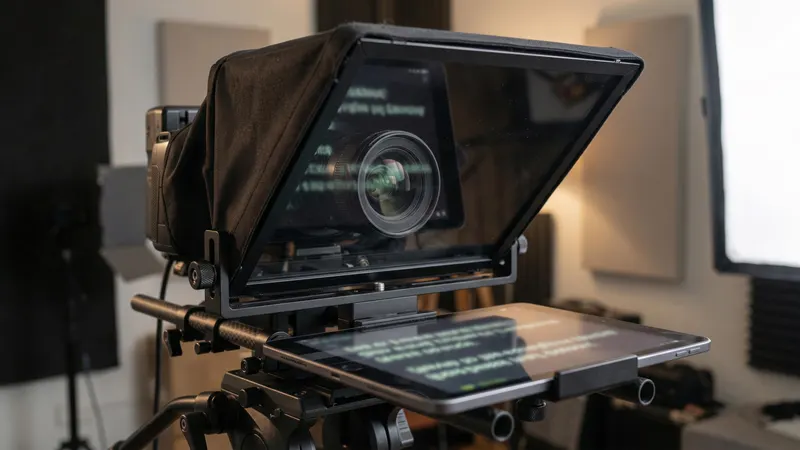
Quick answer
Teleprompter glass is a beam splitter: a clear pane with a partly reflective coating that reflects a screen's text toward you while the camera films through it. It is not a real mirror, which would block the camera. Plain glass or acrylic also works, with a dimmer image.
Free online teleprompter
Paste your script and read it on camera. Runs in your browser; your script is never uploaded.
How teleprompter glass works
A glass teleprompter has a screen lying flat below the lens and a pane above it at 45 degrees. The pane does two jobs at once:
- It reflects some of the screen’s light toward you, so you see the text floating in front of the lens.
- It transmits most of the light from you to the camera, so the camera films you through the pane.
The camera does not see the text because the screen faces up, not toward the lens, and the area behind the glass is kept dark. That is why a teleprompter can put the words exactly where your eyes should be.
The four options compared
| Pane | How it behaves | Pros | Cons |
|---|---|---|---|
| Beam-splitter glass | Coated, splits light | Bright, sharp reflection | Costs more; ordered to size |
| Plain glass (e.g., picture frame) | Reflects a little from each surface | Free or nearly free; optically flat | Dim text; faint double image |
| Clear acrylic | Like plain glass, lighter | Light and shatter-resistant; easy to cut | Scratches easily; can flex and distort |
| Real mirror | Reflects nearly everything | Very bright text | Camera can’t see through: unusable |
Beam-splitter glass is coated to reflect a set share of light and transmit the rest, which gives a bright, single, sharp reflection; it is made for the job, but costs more and must be ordered to size.
A one-way mirror film on acrylic sits between plain acrylic and beam-splitter glass: more reflection than plain acrylic, but easier to scratch and less flat than coated glass.
What 70/30 and 60/40 mean
Beam-splitter glass is sold by how it splits light, written as two percentages that add up to 100. Prompter People, for example, names its glass “60/40”, and Neewer names a DIY splitter “30T/70R” (30% transmission, 70% reflection).
- More transmission (the larger number going to the camera): a cleaner, brighter image, but dimmer text for you.
- More reflection: brighter text, but less light reaching the camera.
The order of the two numbers is not standard between sellers, which is why Neewer adds T and R. Before you buy, check which number is transmission.
Light loss in numbers. A pane that transmits 70% of the light to the camera costs the camera about half a stop of exposure (a full stop is a 50% loss). At 60%, it is a little under three-quarters of a stop. In practice, that is easy to make up with a bit more light on your face.
Which to choose:
| Situation | Better pick |
|---|---|
| Bright room, sitting close | Higher transmission |
| Reading from farther away, dimmer screen | More reflection for brighter text |
| First rig, testing the idea | Plain glass or acrylic; upgrade later |
In a bright room or under studio lights, sitting close, higher transmission gives the cleanest image. Reading from farther away or with a dimmer screen, more reflection gives brighter text.
Choosing size and thickness
- Size: the pane needs to cover the screen’s reflection at 45 degrees. A pane about 1.4 times the screen’s height (the diagonal of a square) covers a screen lying flat beneath it. Most commercial glass is sold to fit a specific hood or tablet size.
- Thickness: thin glass gives a sharper, less doubled reflection. Very thin glass is fragile, so frame it.
- Coating side: beam-splitter glass has a coated side. The coated side faces you and the screen. If the text looks doubled or dim, flip the pane over.
Set it up correctly
- Mount the pane at 45 degrees to the screen below it.
- Center the lens directly behind the pane, as close to it as possible, so the camera does not see the frame.
- Block light behind the pane with a dark hood or fabric around the lens. Light reaching the back of the glass washes out the text and causes reflections in the shot.
- Turn on mirror mode. The online teleprompter at /teleprompter/ has mirror and flip, so the reflected text reads left to right and the right way up.
- Raise screen brightness to maximum and use a bold font with wide margins.
- Clean both sides. Fingerprints show up in the shot and blur the text.
Troubleshooting
| Problem | Likely cause | Fix |
|---|---|---|
| Double text | Plain glass or wrong side | Flip pane; better glass |
| Text too faint | Low reflection or room light | Darken behind; brighter screen |
| Hazy or tinted shot | Dirt or light behind | Clean pane; add hood |
| Camera sees the frame | Lens too far away | Move closer; larger pane |
| Text backwards | Mirror off | Enable mirror in the software |
| Text upside down | Device orientation | Vertical flip or rotate |
More detail: double text comes from plain glass or the coated side facing the wrong way; flip the pane, or use thinner or coated glass. Faint text means not enough reflection or room light on the glass; darken the area behind it, raise screen brightness, or use more-reflective glass. A hazy or tinted shot comes from dirt or light hitting the camera side of the glass.
Do you need glass at all?
Only if your camera is separate from your screen. For phone front-camera videos and laptop webcams, putting the text on the same screen right next to the lens is enough, and no glass is needed.

Record it on your phone
TeleP scrolls your script over the iPhone camera while you record, then adds captions automatically.
If you want to build a rig, how to make a DIY teleprompter has the materials list and step-by-step build.
Questions and answers
Is teleprompter glass a mirror?
Not a normal one. It is a beam splitter: it reflects part of the light, so you can read the screen, and lets most of the rest through, so the camera can see you. A household mirror reflects nearly everything and would block the camera completely.
What does 70/30 teleprompter glass mean?
It describes how the coating splits light. It is the split between light passed through to the camera and light reflected toward you. Sellers do not all write the two numbers in the same order, so check which figure is transmission (some, like Neewer, label them T and R).
Can I use regular glass for a teleprompter?
Yes, especially for a first or DIY rig. Plain glass reflects a little light from both surfaces, so the text looks dimmer and may show a faint double image. A bright screen, bold font and a dark area behind the glass help a lot.
Why is the text backwards on teleprompter glass?
The glass reflects the screen like a mirror, which reverses it. Turn on the mirror or flip setting in your teleprompter software so the screen shows reversed text and the reflection reads correctly.
Does teleprompter glass reduce image quality?
Slightly. Any glass in front of the lens takes some light and can add reflections. Keep it clean, use glass with an anti-reflection coating on the camera side if you can, and block light from behind the camera.