How Many Words Is a 2-Minute Speech?
 By the TeleP teamUpdated 5 min read
Quick answer
A 2-minute speech is about 260 words at a typical speaking pace of 130 words per minute. A slow speaker needs about 220 words and a fast one about 300. For a strict 2-minute limit, write 230 to 250 words so you finish with a few seconds to spare.
220 to 300 words
Two minutes is a short slot, and every sentence has to earn its place. The word count depends on how fast you talk:
| Pace | Words per minute | Words in 2 minutes |
|---|---|---|
| Slow and deliberate | 110 | 220 |
| Typical presentation pace | 130 | 260 |
| Brisk | 150 | 300 |
Each figure is minutes times words per minute. Use the calculator above to turn any time limit into a word target, and the reading speed test to find which row you are in.
Short speeches near 2 minutes
| Length | 110 wpm | 130 wpm | 150 wpm |
|---|---|---|---|
| 30 seconds | 55 | 65 | 75 |
| 1 minute | 110 | 130 | 150 |
| 90 seconds | 165 | 195 | 225 |
| 2 minutes | 220 | 260 | 300 |
| 2.5 minutes | 275 | 325 | 375 |
For a little more room, see how many words is a 3-minute speech.
What fits in 2 minutes
Two minutes holds exactly one idea. Not two, not a list of five. One point, one example and a clear ending. That makes it the right length for:
- A self-introduction at a job interview, class or networking event
- A short toast at a birthday, retirement or rehearsal dinner
- A thank-you speech for an award or a farewell
- A class assignment or a speech competition round
- A video introduction for an application or a course
- A quick pitch of an idea to your team or a panel
If you have more to say than fits, the answer is to choose, not to speed up. Pick the single point that matters most and save the rest for questions or a follow-up.
A 2-minute structure
- Hook: a question, a striking fact or one line of story (15 seconds, about 30 words)
- Your one point, said plainly (15 seconds, about 30 words)
- One example, story or piece of evidence (60 seconds, about 130 words)
- Close: restate the point and end with a clear line (30 seconds, about 65 words)
That is 2 minutes and about 255 words. Notice how much of it is the example. In a short speech, the example does the persuading; the rest frames it.
Example: a 2-minute self-introduction
About 240 words, just under 2 minutes at 130 words per minute.
Hi, I’m Jordan. Three years ago, I couldn’t write a line of code. Today I lead a team of four developers, and I want to tell you how that happened in one sentence: I said yes to the job nobody wanted.
When our company needed someone to fix the internal booking tool, every engineer was busy. I was in customer support. I knew the tool better than anyone because I heard every complaint about it. So I asked if I could try.
For the next six months I spent my evenings learning, and my days fixing small things. The first fix took me two weeks. It was a button that didn’t work on phones. The second took a week. By the spring I was shipping small fixes every few days, and the engineers had started sending me the bugs they didn’t have time for. I asked a lot of questions, and I wrote every answer down. By the end of the year, support tickets about the tool had fallen sharply, and I was offered a junior developer role.
What I learned is that the unglamorous problems are the best teachers. Nobody is watching, so you’re free to make mistakes. And everybody notices when they’re fixed.
That’s why I’m excited about this role. Your job description mentions migrating legacy systems. That’s the kind of work most people avoid. It’s the kind I’ve built a career on.
Thank you.
One point (say yes to unglamorous work), one story, one clear close. Nothing else.
Why 2 minutes is harder than it looks
Short speeches feel easy to write and often run long. Two reasons:
- Openings eat time. “Good morning, my name is, thank you for having me” can use 10 to 15 seconds, about an eighth of your slot. Get to the point in the first sentence.
- Silent drafts look short. Adults read silently at about 238 words per minute (BPS Research Digest), so a 260-word draft takes just over a minute to read in your head. Out loud, at a speaking pace, it takes two.
How to hit 2 minutes exactly
- Write 230 to 260 words. Check them in the words-to-time calculator.
- Read it aloud standing up with a timer. Over 2:00? Cut a sentence, don’t talk faster.
- Aim to finish at about 1:50. That buffer absorbs nerves and a pause for effect.
- Rehearse with the text scrolling at your target pace in the free online teleprompter. If you keep up comfortably, your timing is right.
- For a hard cutoff, memorize the last sentence so you can jump to it if time runs out.
Recording a 2-minute video
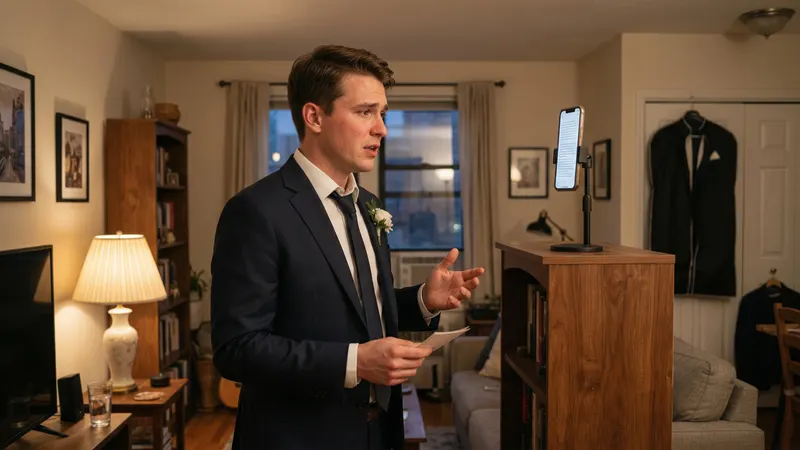
Two-minute videos are common for applications, course introductions and social posts. On camera there is no audience to pause for, so most people run slightly faster; a 260-word script may finish a little under 2 minutes, which suits a strict limit. Reading the script from a phone teleprompter placed right under the camera keeps your eyes on the lens.

Record it on your phone
TeleP scrolls your script over the iPhone camera while you record, then adds captions automatically.
Quick answers
- 30-second speech: about 65 words
- 1-minute speech: about 130 words
- 90-second speech: about 195 words
- 2-minute speech: about 260 words
- 3-minute speech: about 390 words
Questions and answers
How many sentences is a 2-minute speech?
Roughly 15 to 20 sentences if they are short and spoken-style, at about 13 to 17 words each. Shorter sentences are easier to deliver and help you stay on time.
How many paragraphs is a 2-minute speech?
Usually four or five short paragraphs: an opening, two or three body paragraphs and a close.
How many words is a 1-minute speech?
About 130 words at 130 words per minute, or 110 to 150 depending on pace.
Is 300 words too much for 2 minutes?
It is the upper limit. 300 words in 2 minutes is 150 words per minute, which works for a brisk speaker with no pauses. If you expect laughter or want to slow down, cut to about 250.
How many words is a 90-second speech?
About 195 words at 130 words per minute, or 165 to 225 depending on pace.